A TRUNK-MAKER IN PARIS
SINCE 1853
A HERITAGE OF EXCELLENCE
1792
THE ORIGINS OF GOYARD,
MAISON MARTIN
Pierre-François Martin created Maison Martin in 1792. Specialized in box-making, trunk-making and packing, at a time when the golden age of the great trunk-makers of the late 19th century was yet to come, Martin’s trade has more to do with the delicate art of garment folding and packing, than with that of container-making, as was evident by the sign on the façade of his shop.
"Maison Martin sells an assortment of boxes and cases; we provide quality packing services for fragile furniture and objects, as well as hats, gowns and flowers; we use oiled canvas, plain canvas and straw for packing; manufacturer of horse carriage trunks and coat racks, we also supply oilcloth and waterproof canvas, all at a fair price.”
The house of Martin quickly became a favourite with the French aristocracy and was eventually granted the prestigious title of official purveyor to HRH Marie-Caroline of Bourbon-Siciles, Duchess of Berry.
1834
CHANGE OF ADDRESS
In 1834, the House of Martin moved its store from 4, rue Neuve des Capucines to 347,
rue Saint-Honoré. Even though the postal address changed to 233,
rue Saint-Honoré in 1856 on account of a new street numbering system,
its location has remained the same ever since.
1841
MAISON MOREL
A childless widower, Pierre François Martin was the guardian of a young female ward, Pauline Moutat. He arranged her marriage to one of his employees, Louis-Henri Morel, and gave his business as her dowry. Morel followed in Martin’s footsteps and introduced himself as the “Successor to the former Maison Martin, located on rue Neuve-des-Capucines, near Place Vendôme”.
In 1845, Morel hired François Goyard (1828-1890) as an apprentice. The gifted 17-year-old boy received exceptional training under the guidance of both Martin and Morel.
1853
Maison Goyard
When Louis-Henri Morel died suddenly in 1852, François Goyard took over and changed the name of the business to Maison Goyard. He was to remain 32 years at the helm of a house that he took to a whole new level. He finally handed over the reins to his son Edmond in 1885.
1885
Edmond Goyard the innovator
On April 1, 1885, Edmond Goyard officially became the head of Goyard. The name changed to E.Goyard Aîné (the elder). Continuing his father’s work, Edmond Goyard turned the comptoir on rue Saint-Honoré into an international household name.
He created the first Goyard advertisements,
participated in various World Expositions and opened three branch stores in Monte-Carlo, Biarritz, Bordeaux,
as well as trade offices in New York and London, the latter located on Mount Street, on the same street as today’s Goyard Mayfair boutique.
He also developed a range of products for automobiles in collaboration with prestigious coachbuilder Rheims & Auscher...
1890
Pet Chic
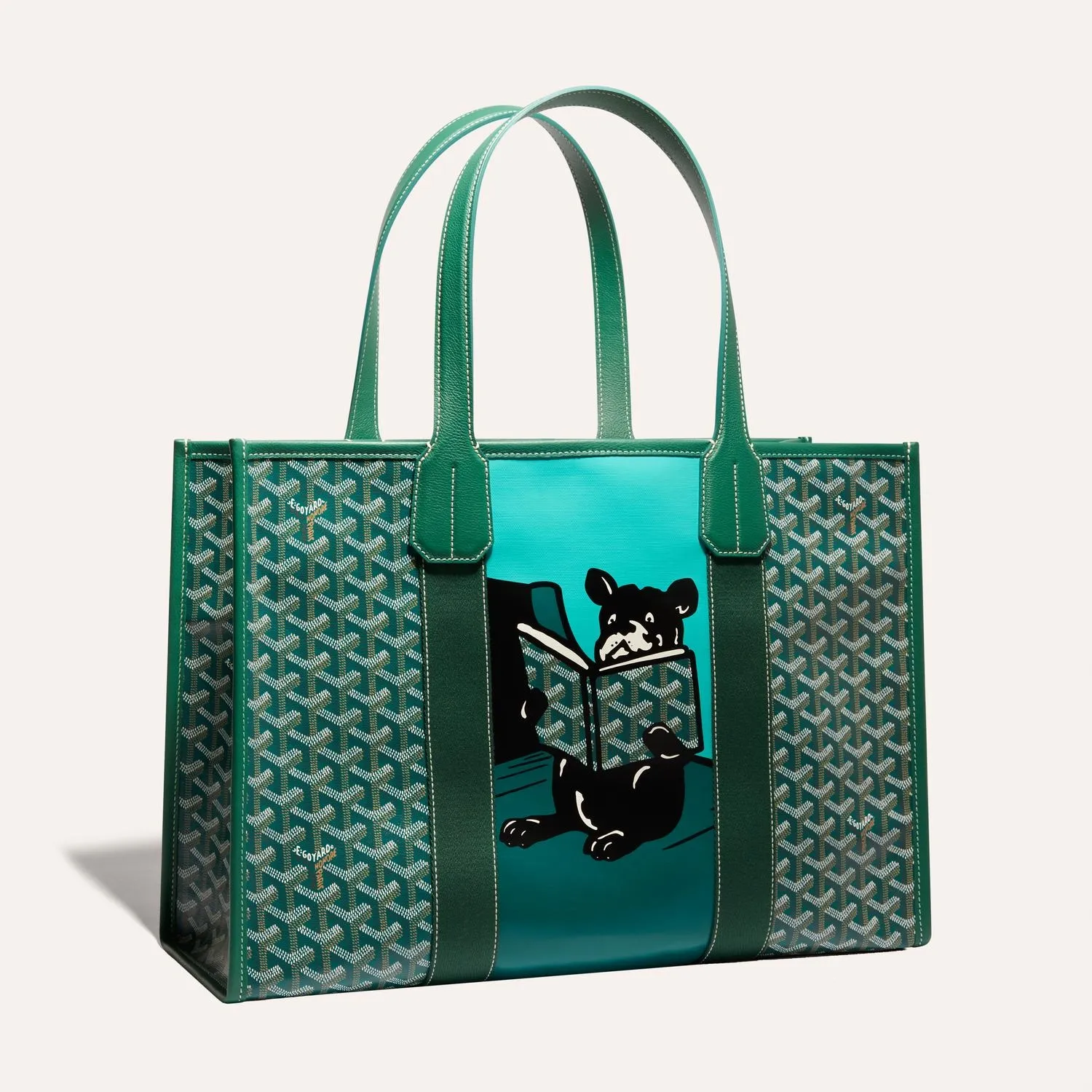
Edmond Goyard started the “Chic du Chien” (“Pet Chic”) range, which met with great success. During the Belle-Époque in Paris, “The chicest dogs wear Goyard”, proclaimed the innovative and playful advertising campaigns imagined for Goyard by the greatest illustrators of the time, such as Pierre Falize, Mich or Benjamin Rabier.
Four-legged dandies dressed up in serge or velvet overcoats, sported driving glasses, boots, ruffle-neck collars and fancy leashes. Specially designed wardrobe trunks were also available. Other pets were not forgotten: cats had their own grooming kits and travel bags, even monkeys had their dedicated line of accessories. Goyard has kept this tradition alive and in 2008, opened a boutique devoted to “Le Chic du Chien” at 352, rue Saint-Honoré, across the street from its historic flagship store.
1891
From the White House to the Winter Palace
Thanks to its creativity and know-how, Goyard was granted the privilege of being the official purveyor to kings and presidents, as is evident on a Goyard letterhead dated 24th June 1891. It features the coats of arms of the British Royal Family, the Russian Imperial family and the Great Seal of the United States of America, still present today on our trunk labels.
Elective affinities since
1853
Throughout the 20th century, Goyard remained a favourite with celebrities, and many illustrious artists, captains of industry, heads of state or royals have sported its creations. One may imagine the extraordinary -and not so unlikely- encounters that could have taken place at 233, rue Saint-Honoré: Pablo Picasso and Sacha Guitry, the Maharadjah of Kapurthala and Jacques Cartier, the Agnellis and the Rockefellers, the Romanovs and the Grimaldis, Estée Lauder and Barbara Hutton, Mrs Pompidou and Prince Ali Khan, Coco Chanel and Jeanne Lanvin, Romy Schneider and Sarah Bernhardt, Edith Piaf and Arthur Rubinstein, Cristobal Balenciaga and Cole Porter, or Jeanne Moreau and Lauren Bacall…
1892
The birth of an emblematic canvas
When he created the Goyardine canvas in 1892, Edmond Goyard was very much inspired by his family history: the dotted pattern clearly references the log drives conducted by his ancestors, and forms a triple chevron juxtaposed in the shape of a Y, the central letter in the Goyard family name.
Just like a painter would sign a painting, Edmond Goyard signed his canvas with his name, thus becoming the very first Parisian trunk-maker to do so.
1900
Universal Exposition
A fearless innovator, Edmond Goyard dared to participate in the World Exposition of Paris in 1900, at a time when it was considered a very bold, if not to say shocking move for a reputable house.
Goyard won a bronze medal, the first of a series of prestigious accolades:
gold medal at the World Exposition of Milan (1906),
gold medal at the Franco-British Exposition of London (1908),
honorary degree at the World Exposition of Brussels (1910),
grand-prix at the Anglo-Latin Exposition of London (1912),
triple grand-prix at the Exposition of Ghent (1913).
Goyard also participated, on a non-competitive basis, in the Panama Pacific International Exposition of San Francisco (1915),
the Exposition of Strasbourg (1919) and the International Exposition of Modern Industrial and Decorative Arts of Paris (1925, honorary degree).
1936
A key player of the French luxury industry
Robert Goyard, along with hotel mogul Charles Ritz and fine-jeweller Louis Boucheron, set up the Comité Vendôme. He personally took care of the legal formalities for its constitution, and even located its offices at Goyard’s headquarters at 233, rue Saint-Honoré. The Comité Vendôme proved instrumental in the shaping of a structured luxury sector in France.
1939 & 1972
A special relationship
with customers
The names of all Goyard customers throughout the 19th and 20th centuries are to be found in Goyard’s filing cabinet, which keeps track of each and every order placed through a system of nominal index cards. They symbolize Goyard’s unique ability to build long-term relationships with its customers, whether they are famous or anonymous.
It is not uncommon for Goyard customers to have accounts that remain active for decades: the Duke and Duchess of Windsor opened theirs in 1939, and it was closed only after the passing of the Duchess in 1986, while Karl Lagerfeld, a great friend of the Maison, opened his in 1972. It was sadly closed in 2019 upon his demise
1974
The birth of a passion
Jean-Michel Signoles came across a vintage Goyard trunk for the very first time in 1974 in an antique shop in Paris, and immediately bought it. His initial curiosity for the Maison soon turned into a passion. He also became an avid collector of remarkable pieces through auctions and chance encounters with other Goyard lovers.
1998
Succession
Upon his purchase of the Maison, Jean-Michel Signoles gradually revived Goyard’s heritage and skills. Fiercely independent, he opened new workshops in France, and boutiques across Europe, the Americas and Asia. Within a decade, with complete disregard for marketing tactics or mass-production, he restored Goyard to its original glory, and firmly re-established it as the beacon of timeless elegance, craftsmanship and exclusivity it once had been.